Audio8 TTS 0.6B is a multilingual text-to-speech model that generates lifelike speech that preserves the speaker’s unique qualities from the original voice.
By providing one sample recording, you are given the flexibility to change the text freely across languages, while the speaker's tone stays recognizably the same.
The main model has 601M parameters, excluding the neural audio codec shipped with it. It is designed for GPU serving through SGLang Omni, with paged attention, dynamic batching, reference-audio encoding, waveform decoding and an OpenAI-compatible speech endpoint.
The 2 layers of DualAR: semantic and acoustic
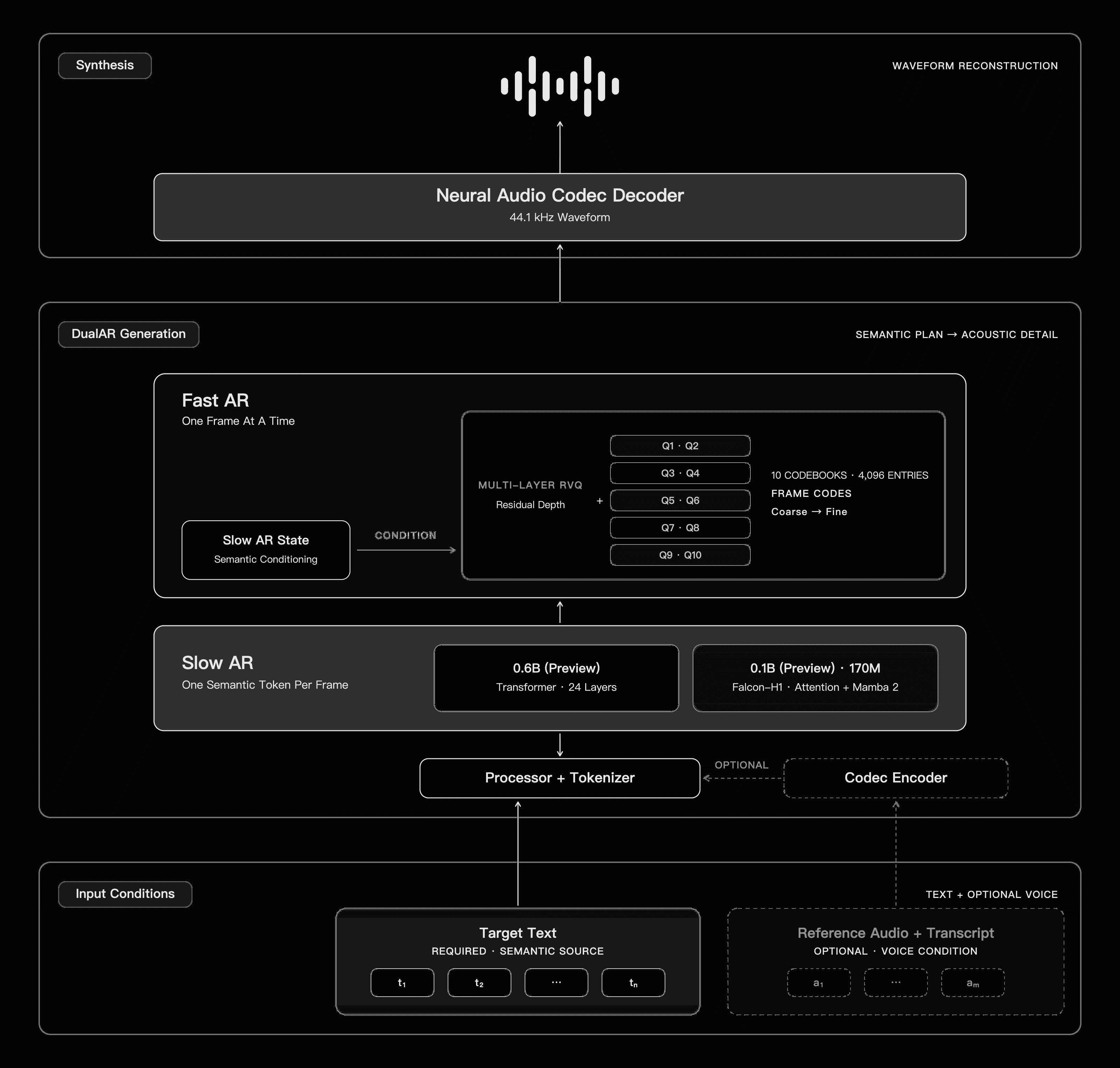
A spoken sentence runs on two time scales. The slow autoregressive stage advances one semantic token per codec frame and sets text alignment, pauses and the overall shape of the sentence. The fast stage reads its hidden states and fills the acoustic codebooks along RVQ depth within the frame. Because the two jobs are separated, long-range structure and local detail do not compete for one token sequence.
Figure 1. Target text is always present; reference audio and its transcript are optional conditions. Slow AR sets the frame-level plan, Fast AR fills the multi-layer RVQ, and the codec reconstructs the waveform.
About 21.5 frames per second; up to 2,048 packed text/audio positions
2,048 samples corresponds to 46.4 ms. Slow AR makes roughly 21.5 semantic decisions per second while fast AR fills each one with ten layers of residual detail. Early codebooks set the rough structure; later ones add timbre, articulation and spectral texture. This depth-wise token budget is what balances coherence against detail.
Just one reference voice is enough
Zero-shot cloning needs no fine-tuning per speaker. The system encodes a short reference recording together with its transcript and passes the pair to DualAR as conditions when generating new text. The transcript is part of the condition, not a note beside the recording: clean audio and accurate text give the most stable results.
Loading selected audio samples...
Multilingual and cross-lingual
Audio8 TTS 0.6B covers Cantonese, Chinese, Dutch, English, French, German, Italian, Japanese, Korean, Polish and Spanish. A Chinese reference can drive an English sentence and similarly, an English reference can drive Chinese. The language of the text changes, but the voice stays consistent.
Powerful performance at a compact scale
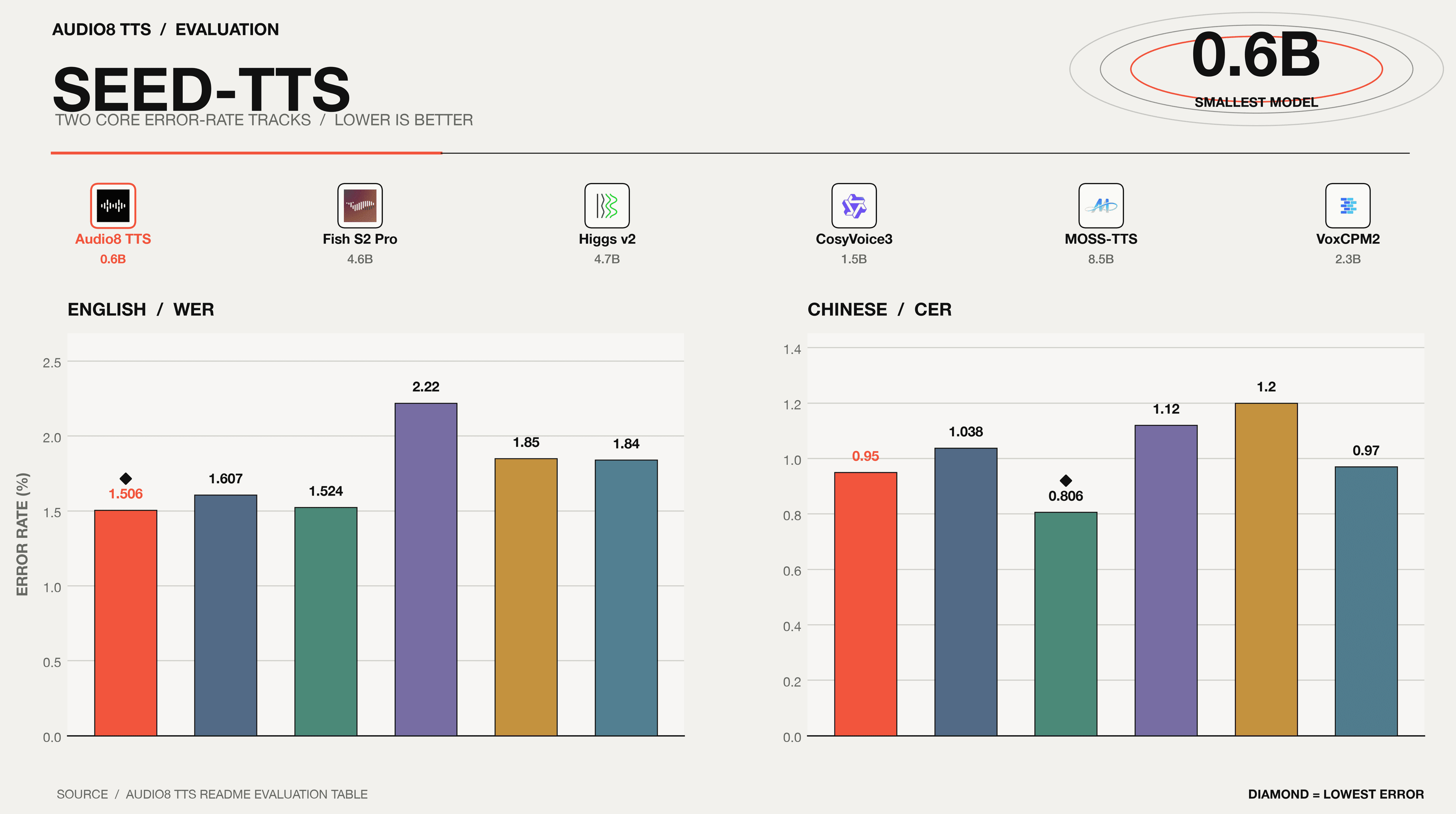
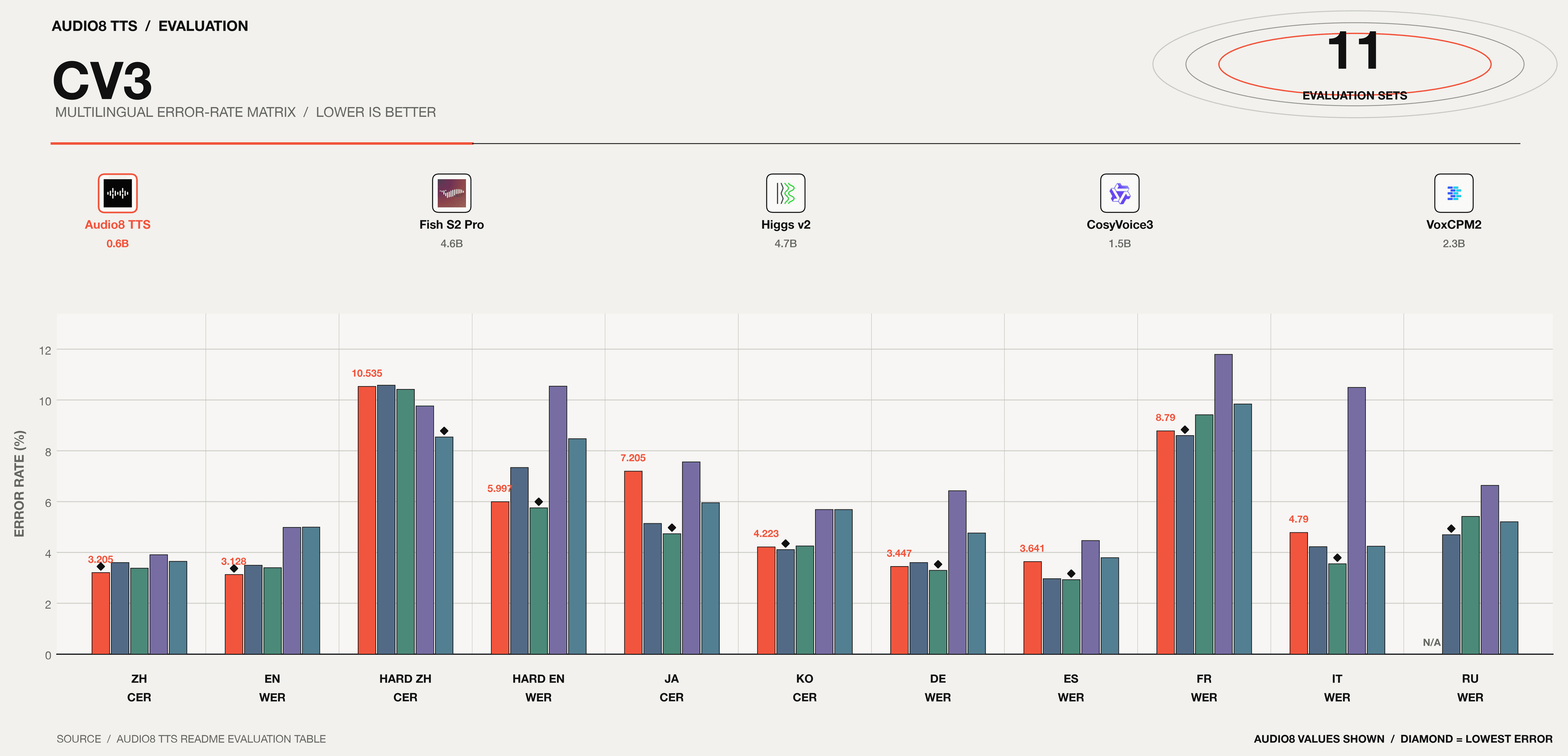
In public Seed-TTS and CV3 comparisons, Audio8 TTS 0.6B is one of the smallest main models included and stays in the leading group for English WER, Chinese CER and multilingual error rates. Projects differ in test sets and normalization, so utilize these as public reference results for your consideration.
Evaluation
Public result
Seed-TTS
EN 1.506 WER / 63.2 SIM; ZH 0.950 CER / 73.1 SIM
CV3
ZH 3.205; EN 3.128; Hard-ZH 10.535
Seed-TTS: lower WER/CER is better; higher SIM is better.CV3: public multilingual error-rate comparison.
The Audio8 repository ships an SGLang Omni adapter with paged attention, dynamic batching, reference-audio encoding, waveform decoding and an OpenAI-compatible /v1/audio/speech endpoint. In a warm, single-stream test on one NVIDIA H20, generating 128 frames took 0.691 s at p50 with an RTF of 0.116, excluding cold start and compilation.